

 한국어
 中文 (中国)
 日本語
 中文 (台灣)
Why did Vietnam shift from Arabica to Robusta? Robusta adapted well to the warmer conditions of Vietnam’s expanding coffee regions, while strong yields and agricultural resilience supported larger-scale production. Today, Tonkin Coffee brings that history into the cup through Fine Robusta-based drinks, including egg coffee, salt coffee and Vietnamese milk coffee.
Why did Vietnam shift from Arabica to Robusta?
Vietnam’s move toward Robusta was not a single decision or a complete replacement of Arabica. Climate suitability, agricultural resilience, production scale and economics gradually made Robusta a practical choice as the country’s coffee-growing regions expanded.
The change becomes easier to understand through four factors:
- Climate: Robusta tolerates warmer conditions than Arabica.
- Yield: Robusta can produce relatively high yields under suitable farming conditions.
- Resilience: The plant is generally more resistant to heat and some diseases.
- Geography: Large parts of Vietnam’s Central Highlands provide suitable conditions for Robusta cultivation.
Together, these factors helped shape a coffee industry increasingly centered on Robusta.
Was Arabica the first coffee introduced to Vietnam?
Yes. Coffee arrived long before Vietnam became strongly associated with Robusta. The history behind when coffee was introduced to Vietnam begins in 1857, when French missionaries brought Arabica coffee into the country.
Early cultivation developed gradually before coffee production expanded into other regions and additional coffee varieties became established. Robusta later proved particularly suitable for areas that would become important to Vietnam’s commercial coffee production.
Did Vietnam completely replace Arabica with Robusta?
No. Vietnam still grows Arabica, particularly in cooler, higher-elevation environments. The major change was that Robusta grew on a much larger scale, eventually becoming far more important to national production.
This distinction matters because Vietnamese coffee is not defined by only one bean. Arabica, Robusta and increasingly higher-quality Fine Robusta all contribute to the country’s modern coffee landscape.
Why was Robusta suited to Vietnam’s expanding coffee regions?
Robusta matched both the environmental conditions and commercial needs of many Vietnamese growing areas. The plant generally performs well in warmer climates and can support productive cultivation where Arabica would be more demanding.
This compatibility became especially important as coffee farming expanded beyond the earliest plantation areas.
How did climate influence Vietnam’s Robusta production?
Arabica generally prefers cooler temperatures and higher elevations, while Robusta is better adapted to warmer tropical conditions. That difference gave growers more flexibility when developing coffee cultivation across suitable parts of Vietnam.
Climate alone did not determine the transition, but climate made large-scale Robusta production practical in regions that later became central to the industry.
Why did the Central Highlands become important for Robusta?
Vietnam’s Central Highlands eventually became the heart of the country’s coffee industry. Provinces such as Dak Lak, Gia Lai and Lam Dong developed substantial coffee-growing areas, although growing conditions and coffee varieties differ across the region.
The transition was gradual. Understanding where Vietnam’s first coffee plantations developed helps explain how cultivation moved from early plantation areas toward regions that were better positioned for large-scale production.
Why did farmers have economic reasons to grow Robusta?
Productivity mattered. Robusta’s yield potential, resilience and suitability for expanding growing regions made the crop commercially attractive.
As Vietnam’s coffee sector developed, export demand and production infrastructure reinforced that advantage. Farmers could grow a crop suited to local conditions while the wider industry had an increasingly established international market for Robusta.
How did Robusta become central to Vietnam’s coffee industry?
Robusta became central through decades of agricultural expansion rather than one sudden shift. Coffee arrived in the 19th century, cultivation spread geographically, and the Central Highlands later emerged as the country’s major production center.
A simplified timeline makes the transition easier to follow:
| Period | Development in Vietnamese coffee |
| 1857 | Coffee was introduced to Vietnam |
| Late 19th century | Early plantations began developing |
| Early 20th century | Robusta and other coffee types became more established |
| Later 20th century | Coffee production expanded strongly in the Central Highlands |
| Today | Vietnam is closely associated with large-scale Robusta production |
The timeline also explains why Vietnamese coffee is unique: agriculture, local drinking habits and generations of adaptation eventually created a coffee culture that is much broader than the bean itself.
How did Robusta shape the taste of Vietnamese coffee?
Robusta helped create the bold, full-bodied coffee profile many people now associate with Vietnam. Common flavor characteristics can include dark chocolate, roasted nuts, caramel, toasted notes and subtle spice, although origin, processing, roasting and brewing all affect the final cup.
The stronger structure also works particularly well with ingredients that add sweetness or creaminess.
Why does Robusta work well in Vietnamese coffee drinks?
A strong coffee base can remain recognizable when paired with condensed milk, egg cream or a creamy salted layer. That balance helps explain the character of several popular Vietnamese drinks.
Vietnamese milk coffee combines coffee with condensed milk. Egg coffee contrasts a deeper coffee base with soft, sweet egg cream, while salt coffee uses a creamy salted layer to create a gentle sweet-savory balance.
For a first-time visitor, understanding what Vietnamese coffee means beyond a single recipe makes these differences easier to appreciate. Vietnamese coffee is a wider culture of beans, preparation methods, ingredients and café habits rather than one fixed drink.
Is Fine Robusta different from ordinary Robusta?
Yes. Fine Robusta focuses on better cherry quality, careful processing, roasting and preparation to create a cleaner and more distinctive cup.
At Tonkin Coffee, Fine Robusta forms the coffee base across signature drinks such as egg coffee, salt coffee and Vietnamese milk coffee. The profile brings chocolate, roasted-nut, caramel and subtle spice notes that remain noticeable alongside creamy ingredients.
Where can travelers experience Vietnamese Robusta coffee in Ho Chi Minh City?
Travelers staying in central Ho Chi Minh City can connect this coffee history with the present at Tonkin Coffee. The brand has four cafés in District 1, with each location fitting a different sightseeing route and pace.
Which Tonkin Coffee location fits a Ben Thanh Market itinerary?
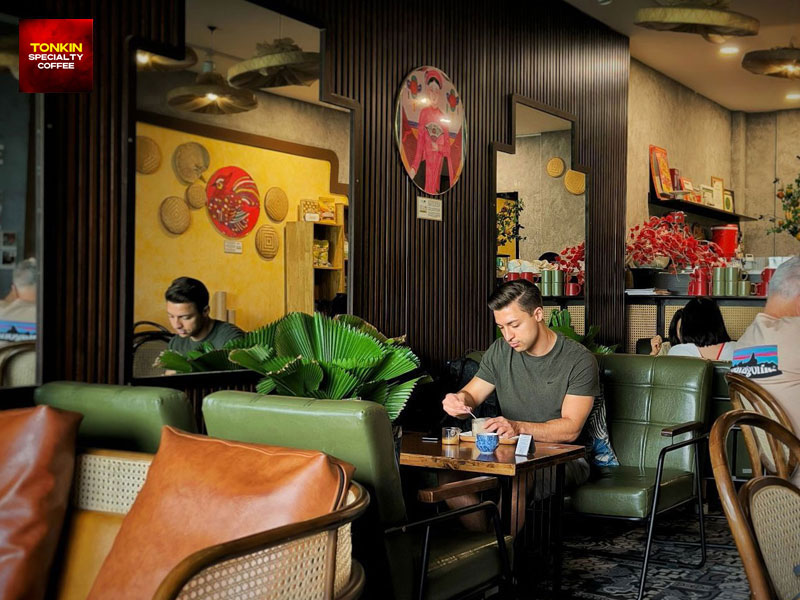
Tonkin Specialty Coffee, at 91 Ly Tu Trong Street, is convenient for a central sightseeing day around Ben Thanh Market. A modest entrance leads upstairs to an intimate space decorated with Vietnamese folk masks, traditional paintings and woven details.
The café gives a historical coffee topic a more tangible ending: instead of only reading about Vietnamese Robusta, visitors can taste how the bean works in contemporary Vietnamese drinks.
Where can visitors take a quieter coffee break?
Tonkin Garden Cafe, at 135/50 Tran Hung Dao Street, offers a different rhythm. Hidden inside a quiet alley, the café combines a green courtyard with a nearly century-old Saigon house.
The garden setting suits visitors who want to spend longer over coffee rather than make a quick stop between attractions.
Where can visitors combine bánh mì and egg coffee?
Tonkin Egg Coffee, at 1 Le Thi Rieng Street, sits opposite the well-known Huynh Hoa bánh mì shop. Guests can bring a Huynh Hoa bánh mì into the café without an additional fee, then pair the meal with egg coffee.
Air conditioning, free Wi-Fi and seating also make the café a practical break around the Tao Dan area.
Which Tonkin Coffee location is convenient near Nguyen Hue and Bitexco?
Tonkin Egg Coffee & Herbal Tea, at 27 Ngo Duc Ke Street, occupies an upstairs space in a historic 1917 villa. The café is convenient for a route connecting Nguyen Hue Walking Street, Bitexco, Dong Khoi and the Saigon River.
The quieter interior creates a useful contrast with the busy streets outside, while coffee and herbal tea offer different ways to slow down during a central Saigon itinerary.
What does Vietnam’s shift to Robusta mean for coffee drinkers today?
Vietnam’s shift toward Robusta was more than a change in agricultural preference. Climate, geography, farming economics and growing international demand helped Robusta become deeply connected with the country’s coffee industry and, eventually, its everyday café culture.
For visitors, that history is still present in the cup. Trying egg coffee, salt coffee or Vietnamese milk coffee at one of Tonkin Coffee’s four District 1 cafés offers a simple way to connect Vietnam’s coffee-growing past with the flavors and café culture of modern Ho Chi Minh City.
Visit Tonkin Coffee Today!
Tonkin Specialty Coffee
- Add: 91 Ly Tu Trong St., Ben Thanh Ward, Ho Chi Minh City, Vietnam.
- Hotline: 086 799 0125
Tonkin Garden Cafe
- Add: 135/50 Tran Hung Dao St., Cau Ong Lanh Ward, Ho Chi Minh City, Vietnam.
- Hotline: 087 992 4691
Tonkin Egg Coffee
- Add: 1 Le Thi Rieng St., Ben Thanh Ward, Ho Chi Minh City, Vietnam.
- Hotline: 0815 841 909
Tonkin Egg Coffee & Herbal Tea
- Add: 27 Ngo Duc Ke St., Sai Gon Ward, Ho Chi Minh City, Vietnam

Nestled in the heart of Ho Chi Minh City, Tonkin Coffee is one of the best coffee shops to experience authentic Vietnamese flavors. From the iconic egg coffee and refreshing coconut coffee to bold Vietnamese coffee and the unique salt coffee, every sip is a journey into tradition. For non-coffee lovers, our Vietnamese matcha offers a gentle alternative. Pair your drink with a freshly baked banh mi or a buttery croissant, and savor the true taste of Vietnam in a setting inspired by folk culture and Indochine charm.