

 한국어
 中文 (中国)
 日本語
 中文 (台灣)
Vietnam’s coffee harvest follows different timelines depending on region, altitude and coffee variety. For travelers asking when is coffee harvest season in Vietnam, the main Robusta crop is typically picked from October to January, while Arabica regions such as Sơn La and Đà Lạt follow different seasonal patterns.
At Tonkin Coffee, understanding harvest timing adds more context to the cup. Origin, cherry ripeness, processing and roasting all influence how Vietnamese coffee develops before it reaches one of Tonkin’s four central Ho Chi Minh City branches.
When does Vietnam’s coffee harvest usually begin and end?
Vietnam does not have one identical harvest calendar for every farm. The country stretches across different climates and elevations, so the timing changes with region, variety, rainfall and the speed at which coffee cherries ripen.
What is the main coffee harvest window in Vietnam?
For the largest coffee-growing areas, October to January is the most useful general window to remember. Central Highlands Robusta often starts coming off the trees around October or November and continues into January.
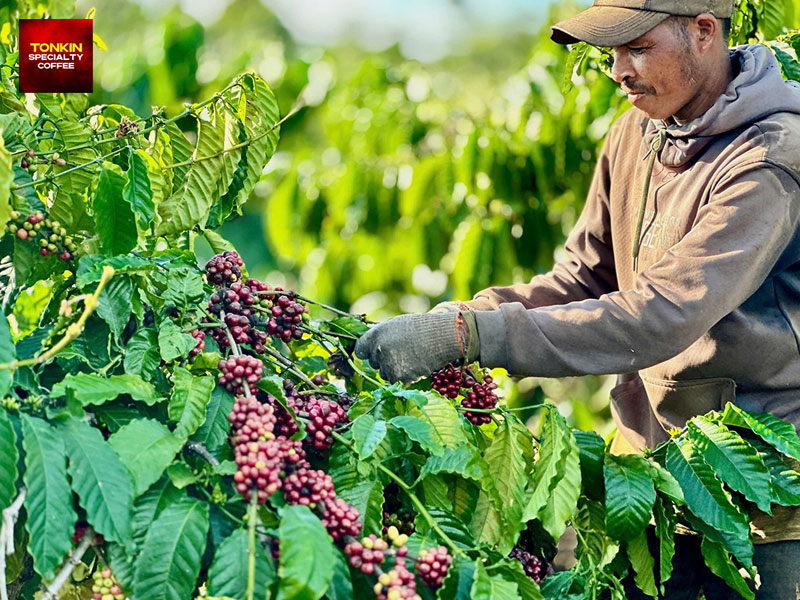
November and December are usually the busiest months. During this period, coffee-growing communities across Gia Lai, Đắk Lắk, Đắk Nông and Kon Tum become noticeably more active with picking, sorting and drying.
Why should harvest dates be treated as approximate?
Coffee cherries do not follow a calendar perfectly. A farm at a higher elevation may ripen later than another farm in the same province, while unusual rainfall can shift picking forward or backward.
For that reason, harvest periods are better understood as seasonal ranges rather than fixed start and end dates.
How does coffee harvest season vary across Vietnam?
Regional differences matter because Vietnam grows both Robusta and Arabica under very different conditions.
| Coffee region | Main coffee | Typical harvest window | Useful note |
| Gia Lai | Robusta | Oct–Jan | Strong activity in Nov–Dec |
| Đắk Lắk | Robusta | Nov–Jan | One of the main Robusta areas |
| Đắk Nông | Robusta | Nov–Jan | Major Central Highlands production |
| Kon Tum | Robusta | Oct–Jan | Some farms can begin earlier |
| Sơn La | Arabica | Sep/Oct–Dec | Earlier northern harvest |
| Lâm Đồng / Đà Lạt | Arabica | Oct–Mar | Higher elevations may run later |
Why does the Central Highlands harvest dominate the national calendar?
The Central Highlands account for a large share of Vietnam’s coffee production, especially Robusta. That is why national harvest discussions often focus on the October-to-January period.
The region’s seasonal rhythm also explains why November and December are such important months for coffee logistics, drying yards and processing activity.
Why does Arabica follow a different schedule?
Arabica is often grown at higher elevations and under cooler conditions. Flowering and cherry development therefore follow a different pattern from low- or mid-elevation Robusta.
That is why northern Sơn La can begin earlier, while some Arabica-growing areas around Đà Lạt and Lâm Đồng may continue later into the dry season.
When is Robusta harvested in Vietnam’s Central Highlands?
Robusta harvesting usually becomes most visible from late October through January, with November and December standing out as the peak period.
Why do November and December matter so much?
By this point, many cherries have reached full ripeness and the rainy season has eased in much of the Central Highlands. Drier conditions make picking and post-harvest drying easier to manage.
The exact week still varies by farm, but late-year travel gives visitors the best chance of seeing widespread harvest activity.
Which provinces are especially important?
The main names to know are:
- Gia Lai
- Đắk Lắk
- Đắk Nông
- Kon Tum
These provinces form the heart of Vietnam’s Robusta landscape.
For readers who want the bigger production picture, how coffee is farmed in Vietnam becomes especially relevant because harvest is only one stage in a much longer cycle that includes flowering, fruit development, picking, processing and drying.
When is Arabica harvested in Sơn La?
Sơn La Arabica is generally harvested earlier than much of the Central Highlands crop, often beginning around September or October and continuing into late autumn or early winter.
Why does Sơn La ripen earlier?
Northern latitude, cooler temperatures, elevation and rainfall patterns all influence flowering and fruit development. The result is a harvest calendar that differs from southern highland Arabica.
If you want more regional context, Sơn La’s reputation for Arabica coffee helps explain why this northern province is frequently discussed separately from Vietnam’s Robusta-producing heartland.
Does every Sơn La farm harvest at the same time?
No. Different elevations, varieties and local weather conditions can shift ripening by several weeks.
A harvest calendar should therefore help with trip planning, but it should never be treated as a guarantee for one specific farm.
When is Arabica harvested around Lâm Đồng and Đà Lạt?
Arabica around Lâm Đồng and Đà Lạt can have one of the broader harvest windows, often stretching from late in the year into the first months of the next.
Why can the harvest continue later around Đà Lạt?
Higher elevation slows fruit development. Microclimates also vary considerably between growing zones, which means cherries do not ripen simultaneously across the province.
Areas around Cầu Đất, for example, can follow a later schedule than lower coffee zones elsewhere in Vietnam.
Can two farms in the same province harvest in different months?
Yes. Altitude, variety, rainfall, flowering time and farm management all affect ripeness.
That is why the phrase “Vietnam coffee harvest season” describes a broad national pattern rather than a single nationwide harvest day.
Why does harvest timing matter for coffee quality?
Harvest timing influences the raw material that eventually reaches the roaster. Picking cherries at the right level of ripeness gives producers better potential for sweetness, balance and cleaner flavor.
Why are ripe red cherries important?
Ripe cherries have had more time to develop sugars and flavor compounds. When harvested carefully, they give processors a better starting point.
Unripe fruit can contribute harsher or less developed flavors, while overripe fruit can create other processing risks.
Is selective picking always possible?
Not always. Selective picking requires more labor and often several passes through the same plot.
Farm size, labor availability, harvest pressure and intended coffee quality can all influence how carefully cherries are selected.
What happens after coffee cherries are picked?
Fresh cherries are not ready for roasting. Harvest is only the beginning of the post-harvest chain.
What are the main steps after picking?
A simplified sequence looks like this:
- Picking
- Sorting
- Processing
- Drying
- Milling
- Grading
- Roasting
- Brewing
Understanding this sequence also makes How does Vietnam’s coffee supply chain work? easier to answer: coffee changes hands and form several times between the farm and the final cup.
How is Robusta commonly processed?
Natural or dry processing is common in many Vietnamese Robusta-growing areas, although other methods are also used. Cherries may be dried before the outer layers are removed, followed by cleaning, grading and preparation for storage or export.
The processing method can significantly affect body, sweetness and clarity.
Does harvest season determine when coffee tastes freshest?
Not directly. Harvest date and drinking freshness are related, but they are not the same thing.
Is coffee freshest immediately after picking?
No. Green coffee still needs to be processed, dried, stabilized, milled and roasted before it becomes a beverage.
For consumers buying roasted coffee, the roast date often matters more directly than the month in which the cherries were harvested.
Why is harvest information still useful?
Harvest timing tells you about crop freshness, regional seasonality and the stage of the agricultural cycle. It also helps explain why different origins appear on menus or become available at different times.
That context can make a cup more meaningful even if the traveler never visits a farm.
Can travelers see coffee harvesting in Vietnam?
Yes, but coffee farms are working agricultural sites rather than guaranteed tourist attractions. The best chances are usually in major growing regions during peak harvest months.

Where is harvest activity easiest to see?
Travelers interested in coffee origin can consider:
- Gia Lai
- Đắk Lắk
- Đắk Nông
- Kon Tum
- Lâm Đồng
- Sơn La
November and December are especially useful for Central Highlands Robusta.
What might travelers see during harvest?
Depending on the farm and timing:
- ripe red cherries;
- workers picking fruit;
- sorting;
- drying yards;
- sacks or lots moving toward processing.
Always contact farms or local operators before making a long trip. Access, harvest timing and weather conditions can change quickly.
Is harvest season the best time to experience Vietnamese coffee?
It depends on what you want to experience.
Visit during harvest if you want:
- farm activity;
- ripe cherries;
- drying and processing;
- a stronger connection to origin.
Visit at any time of year if you want:
- café culture;
- phin coffee;
- Egg Coffee;
- Salt Coffee;
- Vietnamese milk coffee;
- Fine Robusta in the cup.
How does harvest season connect to Tonkin Coffee?
A café cup is the final stage of a much longer agricultural story. Origin, cherry ripeness, processing and roasting all shape what eventually reaches the brewer.
At Tonkin Coffee, that connection is particularly relevant to Fine Robusta. Travelers curious about where to try Fine Robusta coffee in Ho Chi Minh City can use the café experience as a way to connect Central Highlands farming with the final flavor in the cup.
Which Tonkin branch fits each sightseeing route?
| Tonkin Coffee branch | Address | Best itinerary fit |
| Tonkin Specialty Coffee | 91 Ly Tu Trong | Ben Thanh, Independence Palace, City Museum |
| Tonkin Garden Cafe | 135/50 Tran Hung Dao | Bui Vien, Pham Ngu Lao, slower garden break |
| Tonkin Egg Coffee | 1 Le Thi Rieng | Tao Dan, Egg Coffee-focused stop |
| Tonkin Egg Coffee & Herbal Tea | 27 Ngo Duc Ke | Nguyen Hue, Dong Khoi, Bitexco, Saigon River |
For travelers who want to focus more on the coffee itself, Tonkin Specialty Coffee at 91 Ly Tu Trong is an easy fit with central sightseeing. Tonkin Garden Cafe works better for a slower, longer break.
What should travelers remember about Vietnam’s coffee harvest?
Vietnam’s main coffee harvest is concentrated in the final months of the year. Central Highlands Robusta is generally picked from around October or November through January, with November and December especially active. Arabica varies more by region, with Sơn La often beginning earlier and higher-altitude areas around Lâm Đồng continuing later.
The most useful takeaway is that harvest season is not just a date on a calendar. It is the point where ripeness, region and farm decisions begin shaping the flavor that eventually reaches a café in Ho Chi Minh City.
Visit Tonkin Coffee Today!
Tonkin Specialty Coffee
- Add: 91 Ly Tu Trong St., Ben Thanh Ward, Ho Chi Minh City, Vietnam.
- Hotline: 086 799 0125
Tonkin Garden Cafe
- Add: 135/50 Tran Hung Dao St., Cau Ong Lanh Ward, Ho Chi Minh City, Vietnam.
- Hotline: 087 992 4691
Tonkin Egg Coffee
- Add: 1 Le Thi Rieng St., Ben Thanh Ward, Ho Chi Minh City, Vietnam.
- Hotline: 0815 841 909
Tonkin Egg Coffee & Herbal Tea
- Add: 27 Ngo Duc Ke St., Sai Gon Ward, Ho Chi Minh City, Vietnam
Vietnam’s coffee harvest comes alive across the highlands from late in the year.
Ripe coffee cherries mark the beginning of the journey from farm to cup.
From harvest season to Tonkin Coffee, every cup starts with the coffee cherry.

Nestled in the heart of Ho Chi Minh City, Tonkin Coffee is one of the best coffee shops to experience authentic Vietnamese flavors. From the iconic egg coffee and refreshing coconut coffee to bold Vietnamese coffee and the unique salt coffee, every sip is a journey into tradition. For non-coffee lovers, our Vietnamese matcha offers a gentle alternative. Pair your drink with a freshly baked banh mi or a buttery croissant, and savor the true taste of Vietnam in a setting inspired by folk culture and Indochine charm.