

 한국어
 中文 (中国)
 日本語
 中文 (台灣)
Vietnam’s coffee industry changed dramatically in the decades following reunification, developing from relatively limited production into a major global export sector. How did Vietnam’s coffee industry grow after 1975? Economic reforms, expanding cultivation in the Central Highlands and the rise of Robusta all played important roles. Today, Tonkin Coffee connects that history with contemporary Vietnamese coffee culture through Fine Robusta-based signature drinks.
How did Vietnam’s coffee industry change after 1975?
Vietnam did not become a major coffee producer immediately after reunification. The industry first went through a period of reorganization before expanding much more rapidly from the late 1980s and through the 1990s.
Coffee itself already had a long history in the country. The story of when coffee was first introduced to Vietnam goes back to 1857, more than a century before the post-1975 expansion.
Several developments later worked together:
- economic reforms created a more market-oriented agricultural environment;
- coffee cultivation expanded across suitable areas of the Central Highlands;
- farming households became increasingly important to production;
- Robusta emerged as the dominant commercial coffee;
- processing and export networks developed;
- international demand created a large market for Vietnamese coffee.
Why was the late 1980s a turning point for Vietnamese coffee?
The introduction of Đổi Mới reforms in 1986 marked an important economic transition. Greater market participation and changes in agriculture created stronger incentives for farmers to produce crops that could generate commercial income.
Coffee was well positioned for this transition. As cultivation expanded and international trade became increasingly important, the crop moved from a relatively limited agricultural sector toward a major export industry.
Why did the Central Highlands drive Vietnam’s coffee expansion?
The Central Highlands became central to Vietnam’s coffee story because parts of the region offered conditions suitable for large-scale coffee cultivation. Dak Lak, Gia Lai and Lam Dong became important names on Vietnam’s modern coffee map.
This represented a major geographical evolution from the country’s earlier coffee history. A look at where Vietnam’s first coffee plantations developed shows how cultivation gradually moved beyond the early plantation areas before the Central Highlands became the production center familiar today.
Why did Robusta become important to this expansion?
Robusta was well suited to many warmer growing environments and could support productive commercial cultivation. Its yield potential and ability to perform under conditions different from those preferred by Arabica made the variety particularly important as planted areas expanded.
The question of why Vietnam shifted from Arabica toward Robusta therefore cannot be explained by taste alone. Geography, farming economics, production potential and export demand all contributed to Robusta becoming dominant.
Vietnam did not stop producing Arabica. Arabica continues to have a place in cooler, higher-elevation growing areas, while Robusta accounts for the much larger share of national coffee production.
How did economic reforms turn coffee into a major export industry?
Economic reform created an environment in which household farming, commercial production and international trade could expand. Combined with increasing coffee acreage, these changes drove rapid growth during the following decades.
The transformation is easier to see as a timeline:
| Period | Development in Vietnam’s coffee industry |
| After 1975 | Coffee production entered a period of reorganization |
| 1986 onward | Đổi Mới reforms changed the agricultural and commercial environment |
| Late 1980s–1990s | Cultivation expanded rapidly, especially in the Central Highlands |
| 1990s–2000s | Robusta production and international exports grew substantially |
| Recent decades | Greater attention has developed around quality, processing and specialty coffee |
Why did Vietnamese coffee exports grow so strongly?
There was no single reason. Larger cultivated areas increased supply, while Robusta offered a commercially important crop with established international demand. Processing, trading and export networks also developed alongside production.
Vietnam consequently became one of the most significant countries in the international coffee trade. Its modern coffee export position and global ranking reflects decades of agricultural expansion rather than one sudden production boom.
How is Vietnam moving from coffee volume toward coffee quality?
Producing large volumes remains important, but modern Vietnamese coffee is increasingly also a story about quality, origin and processing. Producers and roasters are paying more attention to cherry selection, fermentation, drying, roasting and traceability.
Fine Robusta is particularly relevant to this change. Instead of treating all Robusta as a uniform commodity, quality-focused production can reveal chocolate, roasted-nut, caramel and subtle spice characteristics with a cleaner, more balanced cup.
How did industry growth influence Vietnamese coffee culture?
Agricultural production and café culture are not the same thing, but the growth of Vietnam’s coffee industry provided the foundation for an increasingly diverse drinking culture.
Understanding what Vietnamese coffee means today requires looking beyond one bean or brewing method. Robusta, Arabica, condensed milk, egg cream, salt coffee and changing café styles now coexist within a much broader coffee culture.
For visitors, that evolution is especially visible in drinks such as Vietnamese milk coffee, egg coffee and salt coffee.
Where can travelers experience modern Vietnamese coffee in Ho Chi Minh City?
Tonkin Coffee provides a practical connection between Vietnam’s coffee history and its contemporary café culture. Tonkin has four cafés in District 1, allowing visitors to add Vietnamese coffee naturally to different central Saigon sightseeing routes.
Tonkin uses Fine Robusta as the coffee base across signature drinks, including egg coffee, salt coffee and Vietnamese milk coffee. Fine Robusta is therefore part of the flavor foundation rather than a separate menu drink.
Which Tonkin Coffee location fits a Ben Thanh Market itinerary?
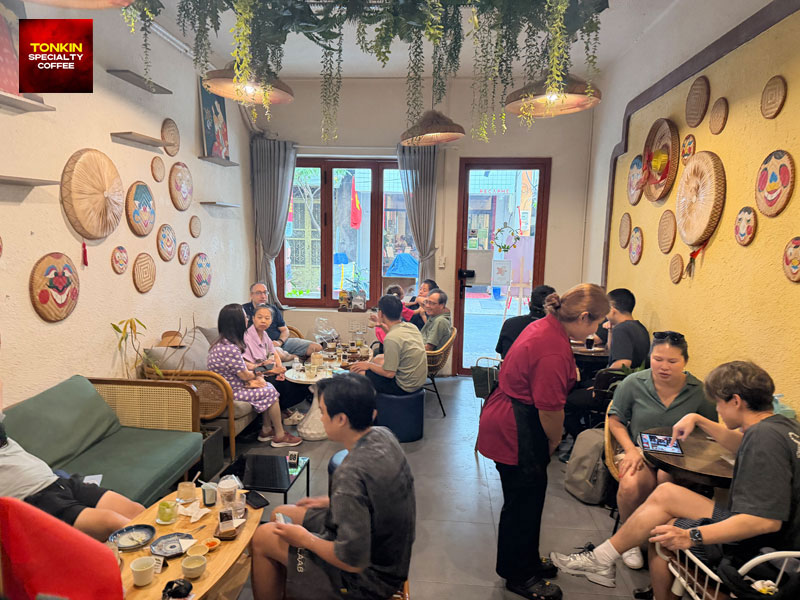
Tonkin Specialty Coffee, at 91 Ly Tu Trong Street, works naturally into a route around Ben Thanh Market and the central District 1 area.
A modest entrance leads upstairs to an intimate café decorated with Vietnamese folk masks, traditional paintings and woven details. The setting adds a cultural layer to the coffee experience without requiring a long detour from major attractions.
Where can visitors slow down in a quieter garden?
Tonkin Garden Cafe, at 135/50 Tran Hung Dao Street, sits inside a quiet alley away from the busier main road.
A green courtyard and nearly century-old Saigon house give the café a slower rhythm. The location suits a longer break when the purpose is not simply to drink coffee and immediately return to sightseeing.
Where can visitors combine bánh mì and egg coffee?
Tonkin Egg Coffee, at 1 Le Thi Rieng Street, is opposite Huynh Hoa bánh mì. Visitors can bring a Huynh Hoa bánh mì inside without an additional fee and enjoy the meal with Vietnamese egg coffee.
The café also provides seating, air conditioning and free Wi-Fi, making the combination convenient around Tao Dan and central District 1.
Which Tonkin Coffee location is convenient near Nguyen Hue and Bitexco?
Tonkin Egg Coffee & Herbal Tea, at 27 Ngo Duc Ke Street, fits easily into a walking route connecting Nguyen Hue Walking Street, Bitexco, Dong Khoi and the Saigon River.
The café occupies an upstairs space in a historic 1917 villa. Its quieter atmosphere offers a noticeable contrast to the busy streets around Nguyen Hue, with both Vietnamese coffee and herbal tea available.
Which Vietnamese coffee should first-time visitors try?
Egg coffee is a good introduction when a visitor wants something distinctly different from a conventional espresso drink. A bold coffee base sits beneath a soft egg cream, creating a contrast between coffee intensity and creamy sweetness.
Salt coffee provides another option, using a creamy salted layer to soften and balance the coffee rather than making the drink taste strongly salty. Vietnamese milk coffee offers the more familiar combination of robust coffee and condensed milk.
Knowing how to drink Vietnamese coffee also makes the experience less intimidating. There is no need to follow one rigid ritual; the best approach is to notice the individual layers first, then adjust or mix the drink according to taste.
What does Vietnam’s post-1975 coffee growth mean today?
Vietnam’s coffee growth after 1975 transformed the country’s agricultural and export landscape. Central Highlands cultivation, Robusta production and international trade helped build the scale of the modern industry, while today’s interest in Fine Robusta shows a growing focus on quality as well as volume.
For travelers, the history becomes easier to understand when it moves from statistics into the cup. Visiting one of Tonkin Coffee’s four District 1 cafés offers that connection: the story of Vietnamese coffee continues through the beans, contemporary drinks and everyday café culture of Ho Chi Minh City.
Visit Tonkin Coffee Today!
Tonkin Specialty Coffee
- Add: 91 Ly Tu Trong St., Ben Thanh Ward, Ho Chi Minh City, Vietnam.
- Hotline: 086 799 0125
Tonkin Garden Cafe
- Add: 135/50 Tran Hung Dao St., Cau Ong Lanh Ward, Ho Chi Minh City, Vietnam.
- Hotline: 087 992 4691
Tonkin Egg Coffee
- Add: 1 Le Thi Rieng St., Ben Thanh Ward, Ho Chi Minh City, Vietnam.
- Hotline: 0815 841 909
Tonkin Egg Coffee & Herbal Tea
- Add: 27 Ngo Duc Ke St., Sai Gon Ward, Ho Chi Minh City, Vietnam

Nestled in the heart of Ho Chi Minh City, Tonkin Coffee is one of the best coffee shops to experience authentic Vietnamese flavors. From the iconic egg coffee and refreshing coconut coffee to bold Vietnamese coffee and the unique salt coffee, every sip is a journey into tradition. For non-coffee lovers, our Vietnamese matcha offers a gentle alternative. Pair your drink with a freshly baked banh mi or a buttery croissant, and savor the true taste of Vietnam in a setting inspired by folk culture and Indochine charm.