

Coffee strength can refer to caffeine, concentration or the intensity perceived in each sip. While espresso is usually more concentrated, a full serving of Vietnamese black coffee may contain more total caffeine because of its Robusta base, larger volume and slower extraction. This guide explains is Vietnamese black coffee stronger than espresso and shows how Tonkin Coffee creates a bold yet smooth Fine Robusta profile from Gia Lai.
Is Vietnamese Black Coffee Stronger Than Espresso in Caffeine or Concentration?
Vietnamese black coffee may be stronger in total caffeine per serving, while espresso is normally stronger in concentration. A single espresso delivers intense flavour in approximately 30 ml, whereas a Vietnamese black coffee serving may range from about 60 to 150 ml.
Common caffeine estimates help illustrate the distinction:
| Comparison | Vietnamese black coffee | Espresso |
| Typical serving volume | Approximately 60–150 ml | Approximately 30 ml per shot |
| Estimated caffeine | Often around 120–200+ mg | Around 63 mg for a single shot |
| Double serving | Recipe dependent | Often around 125–150 mg |
| Concentration per millilitre | Usually lower | Usually higher |
| Common bean base | Often Robusta-led | Frequently Arabica or a blend |
| Typical impression | Full, persistent and roasted | Dense, immediate and compact |
These figures are useful reference points, not universal values. Bean species, ground coffee dose, extraction, cup size and café recipe can move the result considerably.
What Does “Stronger” Mean When Comparing Coffee?
Coffee strength can describe three different qualities.
Total caffeine refers to all the caffeine contained in the finished serving. A larger drink can have more total caffeine even when it is less concentrated.
Concentration describes how much extracted coffee material is present within a given volume. Espresso usually leads in this category because pressure produces a compact drink with a high concentration of dissolved solids.
Perceived flavour intensity refers to how bold, bitter, aromatic or full-bodied a drink feels. This is influenced by the bean, roast, temperature and extraction rather than caffeine alone.
Why Can Vietnamese Black Coffee Contain More Total Caffeine?
The main reasons are the coffee bean, the amount of grounds used and the serving size. Traditional Vietnamese coffee frequently relies on Robusta, which generally has greater caffeine potential than Arabica.
A typical phin serving may also contain more finished liquid than one espresso shot. Even when espresso has more caffeine per millilitre, the larger Vietnamese serving can produce a higher total amount in the cup.
How Do the Coffee Beans Affect the Comparison?
Understanding what beans are used in Vietnamese black coffee is essential because Vietnamese recipes often begin with Robusta or a Robusta-dominant blend. Robusta commonly contains approximately 2–4% caffeine by dry weight, while Arabica is often placed around 1–2%.
These percentages vary by variety and growing conditions, but they explain why a Robusta-based serving may deliver a more noticeable caffeine effect than an Arabica espresso made with a smaller dose.
The comparison is not absolute. Espresso blends may also contain Robusta, while some Vietnamese cafés use Arabica or mixed beans. Species influences caffeine potential but does not decide the result by itself.
Why Does Serving Size Change the Answer?
A 30 ml espresso is designed to be short and concentrated. Vietnamese black coffee is commonly served in a larger volume, sometimes over ice.
Imagine that one drink contains less caffeine per millilitre but three or four times as much liquid. Its total caffeine may still exceed the smaller drink. This is why comparisons should state whether they refer to one ounce, one shot or the complete serving.
A single espresso and a large Vietnamese black coffee are not equal portions. Comparing only their visual darkness or first-sip intensity can therefore be misleading.
How Do Phin Brewing and Espresso Extraction Differ?
Espresso uses pressure to push hot water through finely ground coffee, usually producing a shot in roughly 25 to 30 seconds. The short process creates a concentrated drink with dense aroma and texture.
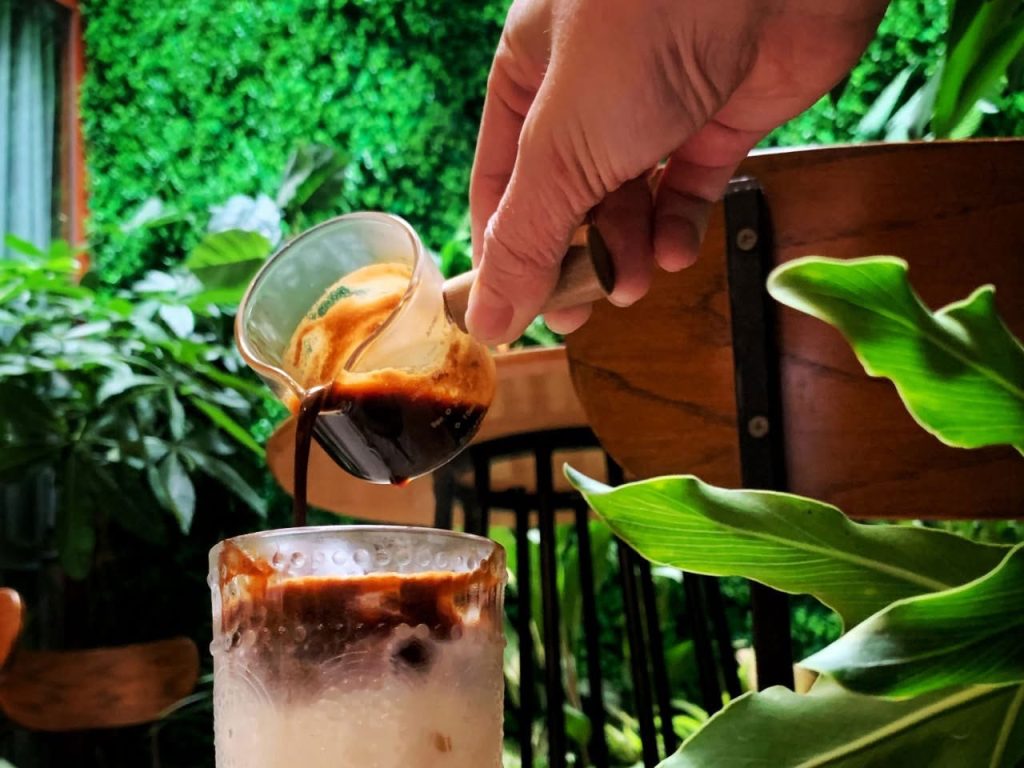
Traditional phin coffee uses a small metal filter placed over the cup. Water moves through the coffee bed by gravity over approximately four to six minutes. The result can be full-bodied, slowly extracted and persistent.
Readers wondering why is Vietnamese black coffee so strong should consider the complete system: Robusta beans, coffee dose, roast, extraction and serving format all contribute.
Does a Longer Brewing Time Automatically Extract More Caffeine?
Not necessarily. A longer contact time can support extraction, but caffeine results still depend on the amount of ground coffee, grind size, temperature, water volume and how evenly the coffee bed is saturated.
Espresso extracts quickly because pressure and fine grounds accelerate the process. Phin coffee extracts more slowly, but often uses a recipe designed to produce a substantial, full-bodied base.
Neither brewing time nor pressure alone proves which finished drink contains more caffeine.
Why Can Vietnamese Black Coffee Taste Stronger Than Espresso?
Vietnamese black coffee may feel stronger because its flavour lasts across a larger serving. A Robusta-led cup can show a heavy body, low acidity, dark chocolate, roasted nuts and a long finish.
Espresso is more concentrated, but its intensity arrives in a small, brief portion. Vietnamese black coffee may be consumed over several minutes, allowing the roasted profile and caffeine effect to feel more persistent.
This distinction also explains why what does Vietnamese black coffee taste like cannot be answered only with the word “strong.” A well-prepared cup can be bold without tasting burnt, flat or excessively harsh.
Does Strong Coffee Have to Be Bitter?
No. Bitterness is one taste component, not a measurement of caffeine or concentration. Dark roasting, low-quality beans and over-extraction can make coffee harsh, but a highly concentrated espresso can still be balanced.
Bean selection and preparation determine can Vietnamese black coffee taste smooth while preserving a substantial body. Fine Robusta can display controlled bitterness, cocoa depth and a clean finish instead of an ashy aftertaste.
This matters because smoothness and strength are not opposites. Coffee can feel powerful yet remain balanced.
Does Ice Make Vietnamese Black Coffee Weaker?
Ice reduces concentration as it melts, but it does not remove caffeine that has already been extracted. The drink may taste lighter over time while retaining nearly the same total caffeine.
This creates two stages:
- The first sips may feel dark and concentrated.
- Later sips become softer as the melting ice adds water.
A full-bodied Robusta base is well suited to this format because its flavour remains noticeable after dilution. Hot Vietnamese black coffee presents aroma and bitterness more directly, while iced coffee evolves gradually in the glass.
Which Drink Should Espresso Drinkers Choose?
Espresso suits people who want immediate intensity in a short serving. Vietnamese black coffee suits those who prefer a longer drink with persistent body and a distinctly Vietnamese coffee profile.
| Choose Vietnamese black coffee when you want | Choose espresso when you want |
| A longer black coffee experience | A compact, concentrated serving |
| A Robusta-forward body | Immediate aroma and density |
| Hot or iced options | A traditional short shot |
| A sustained roasted finish | A fast coffee ritual |
| Direct exposure to Vietnamese beans | A familiar international format |
Visitors comparing more than these two options can use Vietnamese coffee drinks explained for tourists to understand how black coffee differs from egg coffee, salt coffee, coconut coffee and milk-forward drinks.
How Does Tonkin Coffee Balance Strength and Smoothness?
Tonkin Coffee uses Vietnamese Fine Robusta from Gia Lai in the Central Highlands. Its coffee profile is designed to remain bold and recognisable while showing dark chocolate, toasted nuts, light spice and a clean finish.
Careful bean selection and extraction allow the coffee to retain body without relying on burnt flavours. Black coffee offers the clearest way to taste that foundation because there is no milk, cream or coconut layer covering the bean profile.
Guests who find pure black coffee too direct can explore the Tonkin menu, where the same Vietnamese coffee character appears in smoother, sweeter or creamier formats.
Visit Tonkin Coffee Today!
Tonkin Specialty Coffee
- Add: 91 Ly Tu Trong St., Ben Thanh Ward, Ho Chi Minh City, Vietnam.
- Hotline: 086 799 0125
Tonkin Garden Cafe
- Add: 135/50 Tran Hung Dao St., Cau Ong Lanh Ward, Ho Chi Minh City, Vietnam.
- Hotline: 087 992 4691
Tonkin Egg Coffee
- Add: 1 Le Thi Rieng St., Ben Thanh Ward, Ho Chi Minh City, Vietnam.
- Hotline: 0815 841 909
Tonkin Egg Coffee & Herbal Tea
- Add: 27 Ngo Duc Ke St., Sai Gon Ward, Ho Chi Minh City, Vietnam
Nestled in the heart of Ho Chi Minh City, Tonkin Specialty Coffee is one of the best coffee shops to experience authentic Vietnamese flavors. From the iconic egg coffee and refreshing coconut coffee to bold Vietnamese coffee and the unique salt coffee, every sip is a journey into tradition. For non-coffee lovers, our Vietnamese matcha offers a gentle alternative. Pair your drink with a freshly baked banh mi or a buttery croissant, and savor the true taste of Vietnam in a setting inspired by folk culture and Indochine charm.