
 한국어
 中文 (中国)
 日本語
 中文 (台灣)
Choosing the right coffee for egg coffee is less about finding the darkest roast and more about finding enough structure to stand up to the cream. If you are asking what coffee beans are best for Vietnamese egg coffee, look for beans with full body, controlled bitterness and roasted depth rather than intensity alone.
At Tonkin Coffee, Gia Lai Fine Robusta is used for its chocolate-like character, natural sweetness and substantial body, helping the coffee remain clearly identifiable even after the egg cream is mixed in.
Why does Robusta work so naturally with egg coffee?
Robusta is deeply connected with Vietnamese coffee culture, but its suitability for egg coffee is also practical.
A good Robusta can bring substantial body, pronounced roast character and lower perceived acidity than many lighter Arabica coffees. Those qualities create a strong foundation under sweet egg cream.
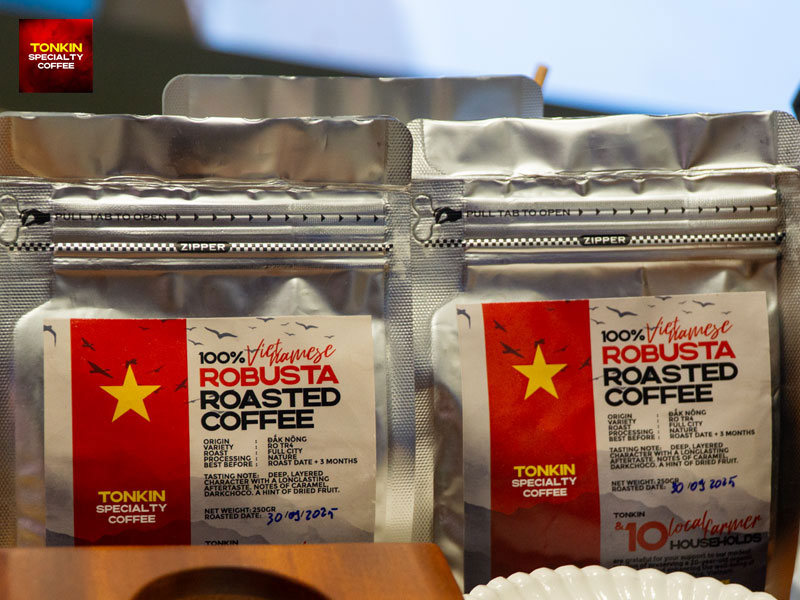
Understanding the broader role of the coffee bean in Vietnam also explains why Robusta appears in so many traditional and modern Vietnamese coffee preparations.
Is stronger always better?
No.
A harsh, overly roasted coffee can clash with the cream just as easily as a weak coffee can disappear beneath it.
The ideal cup has enough bitterness to create contrast, but the finish should remain clean rather than burnt, woody or aggressively rough.
Why is Fine Robusta especially suitable?
Fine Robusta is useful for egg coffee because it combines the structural advantages of Robusta with greater attention to cup quality.
Rather than relying on intensity alone, better-quality Robusta can show sweetness, cocoa, chocolate, roasted nut and spice notes alongside its fuller body.
For readers unfamiliar with the category, understanding what is fine robusta coffee helps separate carefully produced beans from the assumption that all Robusta tastes the same.
How is it different from commodity-style Robusta?
The difference begins before brewing.
Cherry selection, processing, drying, storage and roasting can all affect whether a Robusta cup tastes clean and balanced or rough and flat. A comparison of fine robusta vs regular robusta shows why production quality matters as much as coffee species.
In egg coffee, that distinction becomes important because the coffee needs strength without relying only on harsh bitterness.
What does Tonkin Coffee look for in its coffee base?
Tonkin Coffee uses Fine Robusta from Gia Lai in Vietnam’s Central Highlands.
The aim is not simply to make the drink as intense as possible. The coffee needs enough weight to sit beneath the egg cream while still offering a smooth finish.
The preferred direction includes:
-
Full body
-
Chocolate-like depth
-
Roasted nut character
-
Natural sweetness
-
Noticeable but controlled bitterness
These qualities make it easier for the coffee and egg cream to support each other rather than compete.
The broader robusta coffee flavor profile is useful here because good Robusta can move well beyond a one-dimensional “strong and bitter” description.
Can Arabica work in Vietnamese egg coffee?
Yes. Arabica is not incompatible with egg coffee.
The result, however, can feel quite different.
Some Arabica coffees offer more acidity, floral aroma or fruit character, with a lighter body than Robusta. In a black coffee, those qualities can be elegant and expressive. Under egg cream, a very delicate profile may become harder to detect.
When does Arabica work well?
Arabica can work when the roast and extraction provide enough depth.
A medium-dark roast or concentrated extraction can create more body and roast structure, making the coffee more resistant to being overwhelmed by cream.
Arabica can therefore create a softer or more aromatic egg coffee rather than the heavier, more traditional profile often associated with Robusta.
Are Robusta-Arabica blends a good middle ground?
They can be.
A blend can combine Robusta’s body and bitterness with Arabica’s aromatic complexity.
This approach may suit drinkers who want a strong base without making the cup entirely roast-driven.
There is no universal ideal percentage, because the right balance depends on:
-
Roast development
-
Bean quality
-
Extraction strength
-
Egg cream sweetness
-
Desired final texture
The blend should be judged in the finished drink, not only as black coffee.
What roast level works best under egg cream?
Roast level can matter almost as much as coffee species.
A very light roast may emphasize acidity and delicate aromatics that become difficult to detect under a rich cream. An excessively dark roast can introduce burnt flavors that make the drink heavy.
A more useful target is enough roast development to produce body, chocolate or nutty depth and controlled bitterness.
Does the darkest roast automatically produce the best egg coffee?
No.
Darkness alone does not equal structure.
A balanced medium-to-dark profile can often provide sufficient strength while preserving sweetness and avoiding excessive carbonized flavor.
The goal is not to make the coffee fight the cream. The goal is to give the cream something substantial to balance against.
Does processing method change the result?
Yes, although processing should be treated as one variable rather than the whole answer.
Natural-processed coffees may show more sweetness and fruit depth, while washed coffees can feel cleaner and more defined. Either can work if the final cup has enough body.
For egg coffee, clarity is useful, but thinness is not. Sweetness is welcome, but excessive fermentation character may distract from the cream.
The most successful coffee is the one whose processing character remains harmonious after the egg layer is added.
Does the egg cream affect which beans work best?
Very much so.
The sweeter and heavier the cream becomes, the more structure the coffee generally needs.
That is why questions such as Does Vietnamese egg coffee contain condensed milk? matter beyond the ingredient list. A richer condensed-milk-based cream can soften bitterness more aggressively than a lighter egg mixture.
The same principle applies when asking What is the egg cream in Vietnamese egg coffee made from? Different ratios of egg, sugar, honey, cream or condensed milk can change how much coffee intensity the drink needs.
Bean choice and cream formulation should therefore be considered together.
How can you tell whether the coffee is strong enough?
Instead of judging only the first sip, notice what happens after the layers are combined.

A well-structured coffee should still provide:
-
A recognizable roasted aroma
-
Bitterness that balances sweetness
-
Chocolate, cocoa or nutty depth
-
A finish that still feels coffee-led
If the drink becomes almost entirely sweet and creamy after mixing, the coffee may be too weak for the recipe.
If the finish becomes aggressively bitter, the coffee may be over-roasted or extracted too harshly.
Should freshness matter more than origin?
Origin matters, but freshness and preparation can have an even more immediate effect.
Even excellent beans can taste dull if they are stale, poorly ground or weakly extracted.
For egg coffee, coffee freshness helps preserve aroma and keeps the base from tasting flat once cream is added.
That means bean selection should be viewed as a system:
origin + quality + roast + freshness + extraction + cream balance
No single element guarantees a good cup by itself.
How does Tonkin Coffee use Gia Lai Fine Robusta in egg coffee?
Tonkin Coffee’s approach is built around contrast rather than maximum richness.
The Gia Lai Fine Robusta provides the darker, more structured side of the drink, while the egg cream adds smoothness and sweetness.
The coffee is intended to remain recognizable even after mixing, so the final cup still feels like coffee rather than a dessert with coffee flavor added in the background.
This balance is also why Tonkin Coffee does not need to rely on extreme bitterness. The Fine Robusta provides enough depth without making harshness the defining feature.
Where can you try this style at Tonkin Coffee?
Tonkin Coffee has four central Ho Chi Minh City locations, all offering the same core menu. The most practical branch is simply the one that fits the day’s route.
|
Location |
Address |
Nearby area |
|
Tonkin Specialty Coffee |
91 Ly Tu Trong St. |
Ben Thanh Market, Independence Palace |
|
Tonkin Garden Cafe |
135/50 Tran Hung Dao St. |
Bui Vien, Pham Ngu Lao |
|
Tonkin Egg Coffee |
1 Le Thi Rieng St. |
Tao Dan, central Ben Thanh area |
|
Tonkin Egg Coffee & Herbal Tea |
27 Ngo Duc Ke St. |
Nguyen Hue, Bitexco, Opera House, Saigon River |
Because the core menu is consistent across the four branches, there is no need to choose a location based on the branch name. Location, atmosphere and sightseeing route are more useful deciding factors.
So, which coffee beans are best for Vietnamese egg coffee?
Robusta is often the most natural fit because its fuller body, controlled bitterness and roasted depth can stand up to sweet egg cream. Fine Robusta takes that advantage further by adding cleaner flavor, natural sweetness and greater balance.
Arabica and blends can also work, particularly when roasted and brewed with enough concentration.
The best bean is ultimately the one that remains present after the cream and coffee come together. For Tonkin Coffee, Gia Lai Fine Robusta provides that balance: enough strength to support the cream, while still offering a smooth, chocolate-forward cup rather than relying on bitterness alone.
Visit Tonkin Coffee Today!
Tonkin Specialty Coffee
-
Add: 91 Ly Tu Trong St., Ben Thanh Ward, Ho Chi Minh City, Vietnam.
-
Hotline: 086 799 0125
Tonkin Garden Cafe
-
Add: 135/50 Tran Hung Dao St., Cau Ong Lanh Ward, Ho Chi Minh City, Vietnam.
-
Hotline: 087 992 4691
Tonkin Egg Coffee
-
Add: 1 Le Thi Rieng St., Ben Thanh Ward, Ho Chi Minh City, Vietnam.
-
Hotline: 0815 841 909
Tonkin Egg Coffee & Herbal Tea
-
Add: 27 Ngo Duc Ke St., Sai Gon Ward, Ho Chi Minh City, Vietnam
Nestled in the heart of Ho Chi Minh City, Tonkin Coffee is one of the best coffee shops to experience authentic Vietnamese flavors. From the iconic egg coffee and refreshing coconut coffee to bold Vietnamese coffee and the unique salt coffee, every sip is a journey into tradition. For non-coffee lovers, our Vietnamese matcha offers a gentle alternative. Pair your drink with a freshly baked banh mi or a buttery croissant, and savor the true taste of Vietnam in a setting inspired by folk culture and Indochine charm.