

 한국어
 中文 (中国)
 日本語
 中文 (台灣)
The origin of Vietnamese egg coffee is closely tied to Hanoi in the 1940s, when Nguyễn Văn Giảng was working as a bartender and experimenting with ways to add richness to strong coffee. Historical accounts often ask whether egg coffee was first made at the Metropole Hotel, because that is where the earliest development of the drink is most strongly associated.
Today, Tonkin Coffee carries that Hanoi-born coffee tradition into Ho Chi Minh City through its own interpretation, combining bold Vietnamese coffee with freshly whipped egg cream across four central branches.
What evidence connects egg coffee to the Metropole Hotel?
The Metropole is important to the story because Nguyễn Văn Giảng was working there when the idea for egg coffee began to take shape. Sofitel Legend Metropole Hanoi itself describes egg coffee as having been first created at the hotel in 1946.
Café Giảng’s own history also links the experiment to Nguyễn Văn Giảng’s period as a bartender at the Metropole. The café explains that a shortage of fresh milk encouraged him to try using egg in coffee before he later left the hotel and opened his own business.
Does that mean the exact first cup is fully documented?
Not quite. Historical accounts are consistent about the Metropole connection, Nguyễn Văn Giảng and the year 1946, but the exact first serving is harder to reconstruct.
There is no widely cited record identifying a precise day, table, customer or original serving vessel. It is more accurate to describe the Metropole as the setting where egg coffee was first developed or experimented with.
Why was Nguyễn Văn Giảng experimenting with egg?
The practical challenge was richness. Coffee served with milk had a creamy quality, but fresh milk was difficult and expensive to obtain in Hanoi at the time.
Egg yolk offered another way to create body and texture.
Was milk scarcity really part of the story?
Yes. Café Giảng’s own account describes the drink as emerging during a period when fresh milk was scarce. Whipped egg yolk and sugar created a smooth cream that could be paired with strong coffee.
For a closer look at that historical circumstance, Tonkin Coffee explains how the scarcity of fresh milk influenced egg coffee’s creation.
Was Nguyễn Văn Giảng simply trying to recreate milk coffee?
The idea may have begun as a practical alternative, but the result developed its own character. Whipped egg produced a texture closer to mousse or custard than ordinary milk.
That difference is one reason the drink survived long after milk became easier to obtain.
What happened around 1946?
The year 1946 connects the Metropole experiments with the next major stage of egg coffee’s history.
Nguyễn Văn Giảng eventually left his hotel job and founded Café Giảng in Hanoi. Café Giảng continues to identify 1946 as its founding year and presents egg coffee as the signature creation at the heart of its heritage.
Why is 1946 so important?
It represents the transition from experimentation to establishment.
A simple way to understand the sequence is:
Metropole experiment – Nguyễn Văn Giảng – Café Giảng – Hanoi coffee tradition
The exact first cup may be difficult to pinpoint, but the broader historical sequence is much clearer.
Why is Café Giảng often called the birthplace of egg coffee?
At first, this can sound contradictory. If the drink was developed while Nguyễn Văn Giảng worked at the Metropole, why is Café Giảng also described as its birthplace?
The answer comes down to what “birthplace” means in cultural history.
What is Café Giảng’s connection to egg coffee?
Café Giảng became the permanent home where Nguyễn Văn Giảng’s creation was repeatedly served, remembered and passed through generations. For anyone asking what is Café Giảng’s connection to egg coffee, the answer lies in this continuity: the café helped give the drink a public identity and made it deeply associated with Hanoi.
Café Giảng today explicitly presents itself as the birthplace of Vietnamese egg coffee and continues to emphasize its role in preserving that tradition since 1946.
Can the Metropole and Café Giảng both be important to the origin?
Yes.
The distinction can be understood this way:
|
Historical question |
Best interpretation |
|
Where was the drink first developed? |
Metropole Hotel Hanoi |
|
Who developed it? |
Nguyễn Văn Giảng |
|
Around when? |
1946 |
|
Where did it gain a permanent café identity? |
Café Giảng |
|
Which place preserved the tradition across generations? |
Café Giảng |
The two places represent different stages of the same history.
Why did egg coffee survive after milk became easier to obtain?
If egg coffee had remained only a substitute for milk, it might have disappeared once ingredients became more accessible. Instead, customers continued drinking it because the combination had developed a distinctive sensory identity.
What makes egg coffee different from ordinary milk coffee?
The whipped egg layer adds:
-
airy creaminess;
-
gentle sweetness;
-
custard-like richness.
The coffee underneath adds:
-
bitterness;
-
roast character;
-
depth.
Together, the two layers create contrast rather than simply making coffee creamier.
Why did the drink become associated with Hanoi?
Café Giảng gave customers a place to return to for the same distinctive experience. Over decades, the drink became connected with family continuity, Hanoi streets and generations of customers.
That is how an improvised solution became a cultural specialty.
Who was the person behind the Metropole experiment?
Understanding the location is easier when the creator is kept in context.
Readers who want to focus on the individual rather than the hotel can explore Who was Nguyễn Văn Giảng?, including his background as a Hanoi bartender and his role in turning a practical idea into one of Vietnam’s best-known coffee drinks.
His importance lies not only in combining egg and coffee, but in recognizing that the combination could become a drink with its own identity.
Where is egg coffee from in the broader cultural sense?
The short answer is Hanoi.
Even though modern versions are now served in Ho Chi Minh City and elsewhere, the historical roots point north to Hanoi, Nguyễn Văn Giảng, the Metropole and Café Giảng.
For readers who want the geographic story rather than the hotel-specific history, Tonkin Coffee’s guide to where is egg coffee from explains why the drink remains so closely tied to Hanoi.
What did early egg coffee probably taste like?
It is better not to reconstruct one exact original recipe without documentation. What can be described more confidently is the basic flavor structure that made the drink work.
What were the essential elements?
The early idea combined:
-
whipped egg yolk;
-
sugar;
-
strong coffee;
-
a rich, creamy texture.
The cream softened the bitterness while the coffee prevented the drink from tasting like a simple dessert.
Do modern versions have to taste exactly the same?
No. Modern cafés may change the bean origin, sweetness, cream density, aroma or serving style.
What usually remains recognizable is the basic relationship between rich egg cream and a bold coffee base.
How did the drink move from a hotel experiment to a café tradition?
This transition is arguably more important than identifying a single first cup.
At the Metropole, the idea took shape. At Café Giảng, the drink gained repetition, customers and continuity.
Why does repetition matter in food history?
A recipe becomes a tradition when people can experience it again and again.
Café Giảng allowed egg coffee to move through a clear sequence:
experiment – signature drink – customer memory – cultural heritage
That is why the café remains central even when discussing the Metropole origin.
Can egg coffee traditions be experienced outside Hanoi today?
Yes. Egg coffee began in Hanoi but has become part of the wider Vietnamese coffee landscape.
Modern cafés can respect the origin without claiming to reproduce the exact historical recipe.
What should a respectful modern interpretation preserve?
At minimum:
-
recognition of the Hanoi origin;
-
a clear coffee base;
-
smooth egg cream;
-
balance between sweetness and bitterness;
-
transparency about the café’s own approach.
How does Tonkin Coffee interpret egg coffee in Ho Chi Minh City?
Tonkin Coffee offers its own version of this Hanoi-born tradition rather than presenting the drink as a copy of the Metropole or Café Giảng formula.
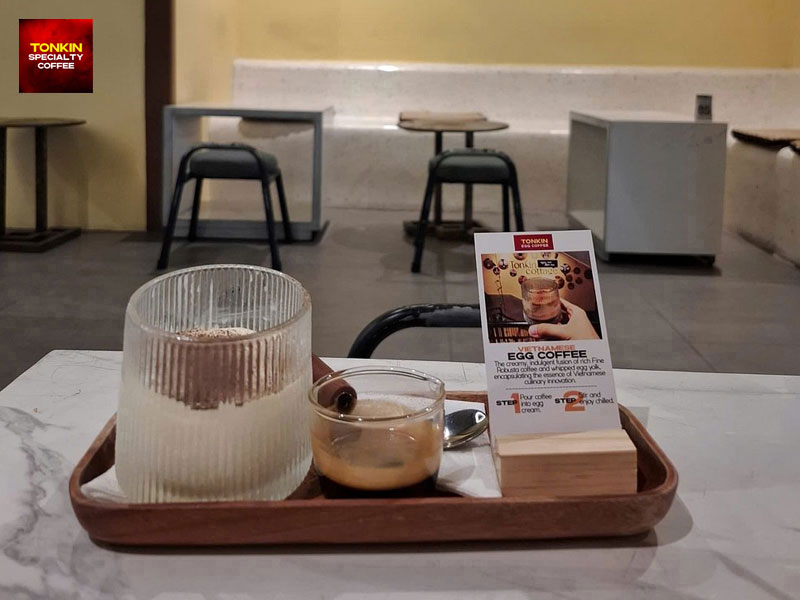
The coffee base uses Fine Robusta from Gia Lai, giving the cup a bold body with chocolate-like notes. The egg cream is whipped fresh with egg, honey, sugar and a small amount of rum to soften unwanted egg aroma.
What remains connected to the original idea?
The central contrast is preserved: a smooth, rich upper layer sits against strong Vietnamese coffee underneath.
Travelers can first taste the cream, reach the coffee below, then lightly combine both layers to understand how the flavors change.
Where can travelers try Tonkin Coffee’s version in Ho Chi Minh City?
Tonkin Coffee has four central branches that fit different sightseeing routes.
|
Branch |
Address |
Best route |
|
Tonkin Specialty Coffee |
91 Ly Tu Trong |
Ben Thanh Market, Independence Palace, City Museum |
|
Tonkin Garden Cafe |
135/50 Tran Hung Dao |
Bui Vien, Pham Ngu Lao |
|
Tonkin Egg Coffee |
1 Le Thi Rieng |
Tao Dan, egg-coffee-focused stop |
|
Tonkin Egg Coffee & Herbal Tea |
27 Ngo Duc Ke |
Nguyen Hue, Dong Khoi, Bitexco, Saigon River |
For a visit focused mainly on the drink, Tonkin Egg Coffee at 1 Le Thi Rieng is the most direct choice. For a central sightseeing route, 91 Ly Tu Trong works naturally with Ben Thanh Market and nearby historic landmarks.
Was egg coffee first made at the Metropole Hotel after all?
The most useful historical interpretation is that Nguyễn Văn Giảng first developed or experimented with egg coffee while working at the Metropole Hotel in Hanoi around 1946. Café Giảng then gave the drink a permanent home, public identity and multi-generational legacy.
The Metropole therefore represents the experimental beginning, while Café Giảng represents the café tradition that followed. Modern interpretations, including Tonkin Coffee in Ho Chi Minh City, show how that Hanoi-born idea continues to evolve without erasing where the story began.
Visit Tonkin Coffee Today!
Tonkin Specialty Coffee
-
Add: 91 Ly Tu Trong St., Ben Thanh Ward, Ho Chi Minh City, Vietnam.
-
Hotline: 086 799 0125
Tonkin Garden Cafe
-
Add: 135/50 Tran Hung Dao St., Cau Ong Lanh Ward, Ho Chi Minh City, Vietnam.
-
Hotline: 087 992 4691
Tonkin Egg Coffee
-
Add: 1 Le Thi Rieng St., Ben Thanh Ward, Ho Chi Minh City, Vietnam.
-
Hotline: 0815 841 909
Tonkin Egg Coffee & Herbal Tea
-
Add: 27 Ngo Duc Ke St., Sai Gon Ward, Ho Chi Minh City, Vietnam
Nestled in the heart of Ho Chi Minh City, Tonkin Coffee is one of the best coffee shops to experience authentic Vietnamese flavors. From the iconic egg coffee and refreshing coconut coffee to bold Vietnamese coffee and the unique salt coffee, every sip is a journey into tradition. For non-coffee lovers, our Vietnamese matcha offers a gentle alternative. Pair your drink with a freshly baked banh mi or a buttery croissant, and savor the true taste of Vietnam in a setting inspired by folk culture and Indochine charm.