

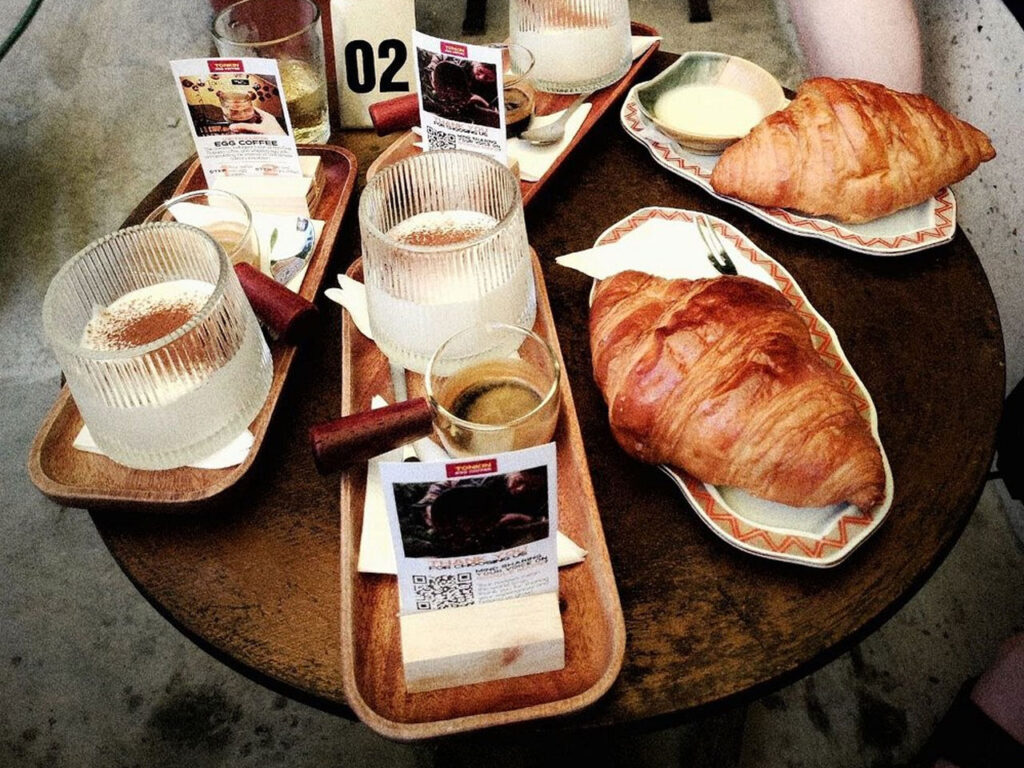
Egg coffee is a custard-like Vietnamese beverage created in 1940s Hanoi by layering whipped egg yolk cream over strong Robusta coffee. What began as a practical solution during milk shortages gradually became a defining symbol of Egg coffee and Vietnamese café culture: slow, communal, and quietly inventive. Today, that spirit continues at Tonkin Coffee, where tradition is respected while technique is carefully refined.
How did egg coffee begin in Vietnam?
Egg coffee emerged in Hanoi in the 1940s when fresh milk was difficult to obtain. A local bartender experimented with whisked egg yolks as a substitute, creating a creamy topping that paired surprisingly well with dark coffee.
Milk shortages in 1940s Hanoi
During the post-war years, imported dairy products were scarce. Coffee, however, remained part of daily life, especially in urban areas influenced by French colonial café traditions. The absence of milk encouraged improvisation. Whisked egg yolks mixed with sugar and condensed milk offered richness without requiring fresh cream.
The bartender behind the invention
When discussing who invented egg coffee, most historical accounts trace it to Nguyễn Văn Giảng, who worked at the Sofitel Legend Metropole Hotel in Hanoi. His experiment eventually led to the opening of Café Giảng, a place that still serves the drink in its traditional style.
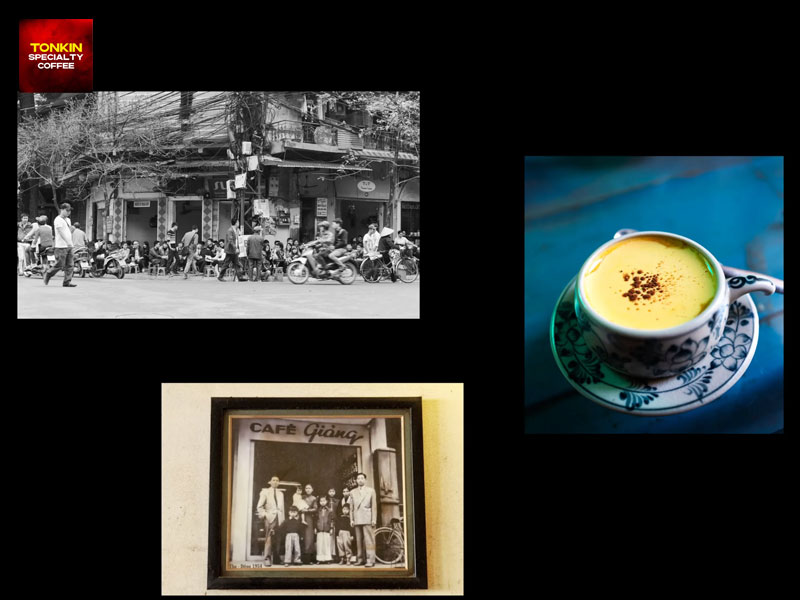
This origin story forms an essential chapter in the history of egg coffee in Vietnam.
From necessity to cultural symbol
What started as substitution gradually became identity. Over time, egg coffee stopped being a workaround and began to represent Vietnamese adaptability. Today, it stands not merely as a beverage but as a reflection of how local culture reshapes foreign influences into something distinct.
What makes egg coffee different in taste and preparation?
Egg coffee stands apart because of its texture and balance. The upper layer is airy and sweet, while the coffee beneath remains bold and structured.
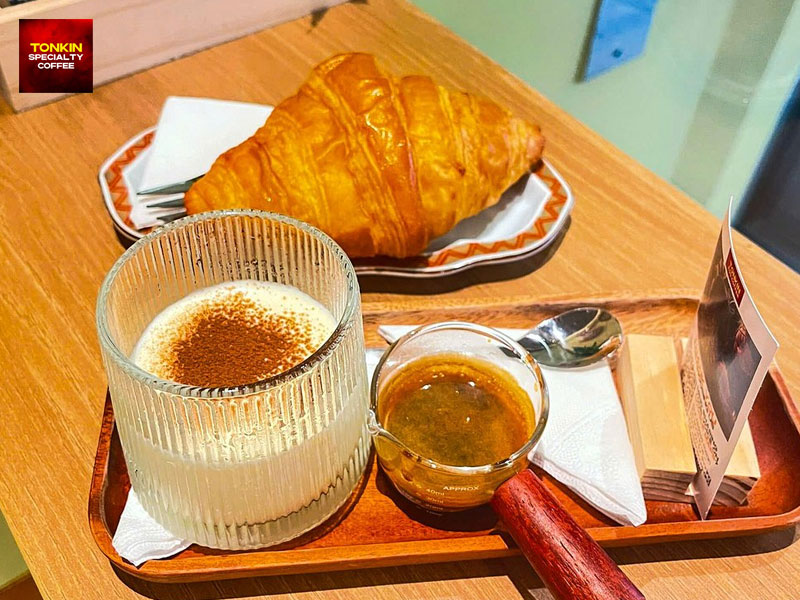
Together, they create contrast rather than uniformity.
Key ingredients
Traditional egg coffee typically includes:
- Fresh egg yolks
- Sugar
- Condensed milk
- Dark Vietnamese Robusta coffee
The yolks are whisked until light and thick, forming a foam that resembles soft custard. When carefully prepared, it has a texture similar to liquid tiramisu, smooth yet structured enough to sit above the coffee.
Traditional preparation method
Anyone exploring how to make authentic Hanoi-style egg coffee will notice that technique matters as much as ingredients. The yolks must be beaten long enough to become airy without collapsing. The coffee beneath is usually brewed strong, often using a phin filter so it can support the sweetness above.
The cup is sometimes placed in a bowl of warm water to maintain temperature. This detail allows the foam to remain soft while keeping the coffee hot.
Hot and iced variations
While the original version is served warm, modern adaptations include iced egg coffee. In southern Vietnam, chilled variations have become popular, especially in warmer climates. Despite the temperature shift, the balance between sweet foam and bitter coffee remains central.
How does egg coffee reflect Vietnamese café culture?
Egg coffee reflects a style of café culture centered on conversation, patience, and shared space. It is not designed for haste but for gradual enjoyment.
Cafés as social spaces
Across Vietnam, cafés function as informal meeting points. Students gather to study, friends sit for hours over a single drink, and professionals hold casual discussions away from formal offices.
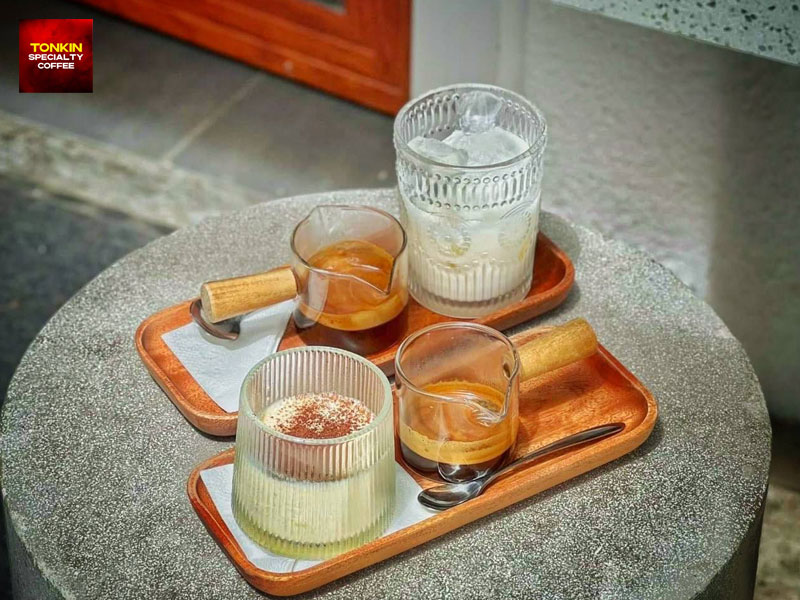
The drink itself: small in portion but rich in texture encourages slow sipping rather than quick consumption.
Ritual of serving and sipping
Traditional egg coffee often arrives in a small cup nested inside a bowl of hot water. This presentation subtly signals that the drink should be taken slowly. One may stir the foam gently into the coffee or taste the layers separately. The ritual reinforces the broader rhythm of Vietnamese café life: unhurried and communal.
European influence, Vietnamese reinterpretation
Vietnamese coffee culture evolved from French colonial influence, yet it developed along its own path. The use of condensed milk, dark roasted beans, and inventive methods like egg foam demonstrate adaptation rather than imitation. Egg coffee embodies this reinterpretation, transforming European-style café habits into something uniquely local.
Where can you experience egg coffee today?
Egg coffee can be found in many Vietnamese cities, yet its character varies depending on preparation and bean quality. A refined version balances texture, sweetness, and the structure of the coffee beneath.
What defines a refined egg coffee?
A well-crafted egg coffee depends on several factors:
- Fresh eggs, whisked to a cloud-like consistency
- Controlled sweetness, sometimes enhanced with honey
- A subtle aromatic note to remove any raw egg scent
- A balanced, well-extracted shot of coffee
The foam must remain light rather than heavy. The coffee must stay aromatic without sharp bitterness.
Inside a glass at Tonkin Coffee
At Tonkin Coffee, the preparation reflects attention to both texture and temperature.
The egg cream begins with fresh yolks whipped until airy. A small amount of sugar and honey provides sweetness. A few drops of rum are added, not to dominate the flavor, but to neutralize any unwanted egg aroma while preserving richness. Fresh cream contributes softness, and a light dusting of cocoa powder adds a faint bitterness that rounds out the profile.
All ingredients are mixed carefully and kept chilled to maintain structure. Even the serving glass is cooled to around 2°C before assembly. This detail ensures the cream holds its shape while remaining smooth.
Beneath the foam sits a single shot of coffee sourced from Vietnam’s Central Highlands. The beans used are Fine Robusta, chosen for their depth and natural sweetness. The extraction aims for balance: full aroma without harshness, strength without aggressive bitterness.
The result is layered. The first sip may carry chocolate notes from the cocoa powder. The middle reveals sweetness and creaminess. The final impression comes from the coffee itself: clean, structured, and steady.
Visit Tonkin Coffee Today!
Tonkin Specialty Coffee
- Add: 91 Ly Tu Trong St, Ben Thanh Ward, District 1, Ho Chi Minh City, Vietnam.
- Hotline: 086 799 0125
Tonkin Garden Cafe
- Add: 135/50 Tran Hung Dao St, Ben Thanh Ward, District 1, Ho Chi Minh City, Vietnam.
- Hotline: 087 992 4691
Tonkin Egg Coffee
- Add: 1 Le Thi Rieng, Ben Thanh Ward, District 1, Ho Chi Minh City, Vietnam.
- Hotline: 0815 841 909

Nestled in the heart of Ho Chi Minh City, Tonkin Specialty Coffee is one of the best coffee shops to experience authentic Vietnamese flavors. From the iconic egg coffee and refreshing coconut coffee to bold Vietnamese coffee and the unique salt coffee, every sip is a journey into tradition. For non-coffee lovers, our Vietnamese matcha offers a gentle alternative. Pair your drink with a freshly baked banh mi or a buttery croissant, and savor the true taste of Vietnam in a setting inspired by folk culture and Indochine charm.